


Saturday, 22 August 2026
Wednesday, 5 August 2026
Balkrishna Doshi’s Aranya Low Cost Housing

FROM BALKRISHNA DOSHI:
“They are not houses but homes where a happy community lives. That is what finally matters.” Aranya Low Cost Housing accommodates over 80,000 individuals through a system of houses, courtyards and a labyrinth of internal pathways.
“It seems I should take an oath and remember it for my lifetime: to provide the lowest class with the proper dwelling.” The community is comprised of over 6,500 residences, amongst six sectors – each of which features a range of housing options, from modest one-room units to spacious houses, to accommodate a range of incomes.

One cannot just be an architect. The idea is to become a sthapati
as described in the canonical texts.... “to be a yogi, to feel the
vibrations of every element in the cosmos including the materials and
the user of that space.”1
—Balkrishna Doshi
source: https://www.cca.qc.ca/en/articles/issues/12/what-you-can-do-with-the-city/58317/balkrishna-doshis-aranya

Tuesday, 4 August 2026

Monday, 13 July 2026
KANAF-crete (building blocks made out of Kanaf!)
 |
Affordable Abodes pioneering KANAF as building block for fast deployment |
Thursday, 23 January 2025
Effective low cost housing in Mongolia
The Ulaanbaatar Housing Corporation, the GIZ, and Hybrid House LLC built an energy saving housing development in Denjiin Myanga of Chingeltei district, Ulaanbaatar city, Mongolia. This is an effective and viable solution to the city’s cheap heating problem that produces carbon monoxide for its residents trying to keep warm.
 |
| South facing maximum Solar exposure |
Wednesday, 10 June 2020

Monday, 18 February 2019
1960's Soviet-era housing facing demolition

“We are not against beauty, we are against superfluity,” Nikita Khrushchev told Soviet architects in 1954.
Speaking a year after Stalin's death, with the Soviet Union damaged by war and repression, Khrushchev ordered a nationwide effort to build housing cheaply and quickly. This, the most ambitious Soviet housing project, gave birth to the Khrushchevka — the distinctive five-story building named after the Soviet leader. Millions of Russians continue to live in them today.
Sixty years on, however, Moscow authorities have decided they have had enough of the Khrushchevka. In a meeting with President Vladimir Putin on March 1, Moscow Mayor Sergei Sobyanin announced plans to demolish around eight thousand of the post-war buildings. This equates to 25 million square meters of living space and will involve re-housing 1.6 million people – the population of a small European capital. The decision took Muscovites by surprise. After all, the plans to demolish a large part of the city had not been discussed in any public sphere, let alone parliament. “They decided everything for us, once again,” prominent architect Yevgeny Asse told The Moscow Times, adding he first heard about the plans on television.
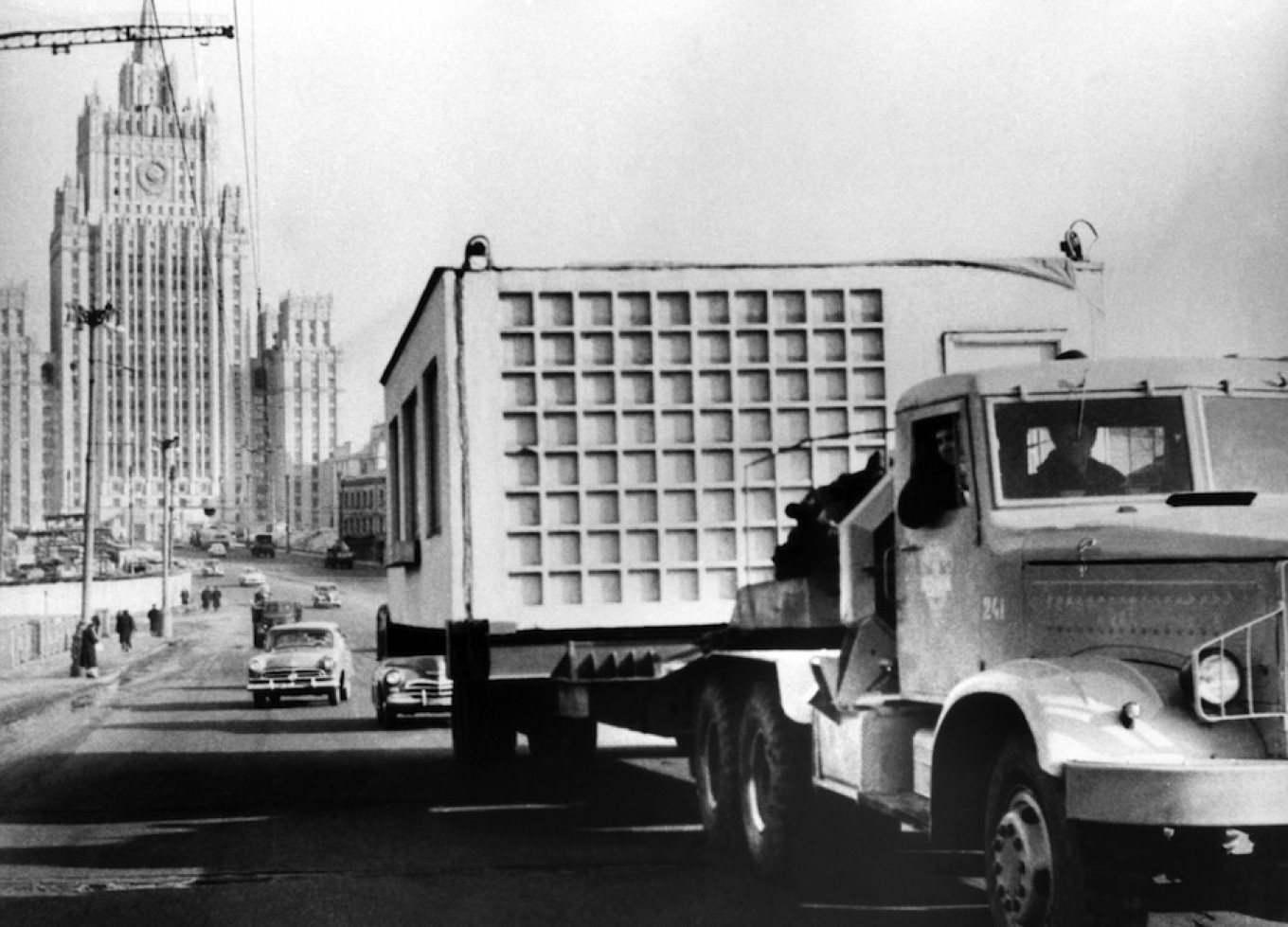
A truck transports parts of a Khrushchevka in 1960, Moscow, Soviet Union.
Read More https://www.themoscowtimes.com/2017/03/09/goodbye-khrushchev
Monday, 14 January 2019
Japan New Wave Public Housing
Kowa Danchi Offers a Renewed Vision of Housing Projects in Japan
The Kowa Public Apartment Complex was planned in Mihama, a coastal town in Aichi prefecture that has suffered from depopulation. A number of 2 and 3-story danchi buildings built in the 1950s plagued with structural deterioration and vacancies were to be torn down and replaced. But rather than building up, the town wanted to prioritize a warmer style of living that was closer to the ground. One that would be friendly to parents raising children but also seniors.
source: https://www.spoon-tamago.com/2018/11/12/kowa-danchi-public-housing-mihama/


Wednesday, 26 December 2018
Best Modular Housing Unit: MOVIT by Pod Structures Singapore
Founded in Singapore in 2015, Pod Structures is a multi-disciplinary design and innovation start-up that produces solutions related to the field of modular and prefabricated construction. Earlier this week the firm launched its pilot modular home project called MOVIT.
Installed at the front lawn of the startup’s office and workshop facility on Loyang Street, the 32-square-metre modular home is decked as a studio apartment comprising a living-dining area, a bathroom and a bedroom.
 |
| source: https://www.indesignlive.sg/happenings/podstructures-launches-movit-modular-home |
Wednesday, 23 May 2018

Wednesday, 1 February 2017

Sunday, 10 July 2016


Monday, 4 January 2016
French Social Housing Experiments (1950s-1980s)
The Fading "Grands Ensembles" of Paris
Laurent Kronental's Souvenir d'un Futur photos capture these stigmatized housing experiments and their aging residents.
From the 1950s to the 1980s, Paris erected a series of massive apartment complexes to address a burgeoning housing crisis and accommodate an influx of foreign immigrants after WWII. Once seen as impressive manifestations of modern and postmodern ideology, these days the buildings are often stigmatized by the public and in the media, viewed largely as places of unemployment, delinquency, and exclusion.


 Source: http://www.fastcodesign.com/3052176/exposure/the-fading-grands-ensembles-of-paris


 Source: http://www.fastcodesign.com/3052176/exposure/the-fading-grands-ensembles-of-paris
Tuesday, 3 November 2015
"Gwapotel" transient worker housing solution in Metro Manila

Sunday, 9 November 2014
Typhoon Haiyan: 1 Year On: 205,000 Families still without Homes
 |
| Families are still staying in a tent city that was set up for survivors of the typhoon in Tacloban, which was largely destroyed in November last year. Some 6,300 people died across central Philippines as Super Typhoon Haiyan whipped up the strongest winds ever recorded on land and generated tsunami-like storm surges more than two-storeys high. -- PHOTO: AGENCE FRANCE-PRESSE |
In a briefing paper, the Office of the Presidential Adviser on Rehabilitation and Recovery defended the pace of reconstruction in the Philippines, saying it has, in fact, been faster than in Banda Aceh in Indonesia, after it was hit by a tsunami in 2004.It said it took two years before Banda Aceh could transition from relief to reconstruction. Most of the rebuilding so far is being done by international aid groups and private foundations, including the Singapore Red Cross, which has raised $12.26 million to fund 87 programmes for some 1.5 million people. Today, Tacloban will mark a year since Haiyan struck with a "candlelight memorial".Thousands are expected to light 24,000 candles along a 24km stretch from the city airport to a memorial park where more than 2,000 of those who died in the city last year were buried.
The powerful Catholic Bishops Conference of the Philippines has declared today a "national day of prayer", instructing all Catholic churches in the archipelago to simultaneously ring their bells at 6pm. A "climate change envoy", meanwhile, will end his one- month, 1,000km march from Manila in Tacloban. Mr Naderev Sano, the Philippine representative to the United Nations' climate change negotiations, and 12 others have been travelling an average of 25km a day since leaving Manila. He made world headlines last year when he fasted during the annual summit in Poland to protest against the lack of meaningful progress on global warming.
Tuesday, 16 September 2014
Akitek Tenggara's legacy
676 experimental two-storey houses, each with a small garden of 13 square metres, were completed in 1976 by Akitek Tenggara's preeminent Tay Kheng Soon and Chung Meng Ker. It was the result of a critical morphological study into alternatives to high-rise and walk-up apartments at densities of up to plot ratio of 2:1. What Cheras showed is that a plot ratio of 0.68:1 is possible at a cost significantly lower than for medium and high-rise solutions. High-density low-rise can even be attractive given its ground-hugging typology. To date, after nearly 20 years and with minimum maintenance, the project still looks reasonably well-maintained. With its tree-lined roads and paths, and little sign of vandalism, it has matured. It also shows that 144 ground-based dwellings, each with a private garden, can be accommodated for each hectare of land.
 http://www.akitektenggara.com/projects/cheras/cheras.htm

Tuesday, 15 April 2014
Paper Housing - Shigeru Ban
Master Architect ! Emergency Shelters and Housing TED TALK

Source: http://www.architectural-review.com/Pictures/web/v/s/t/Shigeru_Ban_Col_0_390.jpg
Source: http://www.architectural-review.com/Pictures/web/v/s/t/Shigeru_Ban_Col_0_390.jpg
Friday, 15 March 2013
Student Housing!
Source: Cattani Architects, Cité A Docks - Le Havre, France - Shiiping Container Student Housing


Friday, 25 January 2013
Open Modular System of Sustainable Houses (SAVMS) / Cso Arquitectura
SAMVS open modular houses make a great solution for low income housing programs
given their fast construction time, simple materials, modularity and
overall efficiency. Comprised of modules that serve specific functions
and are fabricated in a local factory, the home can be built in just
one and half months for 700 Euros per square meter.
Industrial in design, the home nevertheless boasts sensible materials that ensure sufficient thermal massing and ventilation. The interior is light and fresh and the green roof helps with insulation and enhanced air quality. Rainwater is harvested and recycled and the entire home is powered by both solar thermal plates and photovoltaic panels. It’s hard to go wrong with the SAMVS units: they save materials, energy, time and money, and they’re not so hard on the eye either.
source: http://www.archdaily.com/295004/open-modular-system-of-sustainable-houses-savms-cso-arquitectura/


Industrial in design, the home nevertheless boasts sensible materials that ensure sufficient thermal massing and ventilation. The interior is light and fresh and the green roof helps with insulation and enhanced air quality. Rainwater is harvested and recycled and the entire home is powered by both solar thermal plates and photovoltaic panels. It’s hard to go wrong with the SAMVS units: they save materials, energy, time and money, and they’re not so hard on the eye either.
source: http://www.archdaily.com/295004/open-modular-system-of-sustainable-houses-savms-cso-arquitectura/


Saturday, 15 December 2012
Public Housing Design 101
Crime prevention through environmental design (CPTED) is a multi-disciplinary approach to deterring criminal behavior through environmental design.
CPTED strategies rely upon the ability to influence offender decisions
that precede criminal acts. As of 2012, most implementations of CPTED
occur solely within the built environment.
By changing the areas we reside in to deter criminals from committing
acts in our communities is the main goal of CPTED. Urban design and the
planning that goes in to the creation of new and reformation of older
communities, citizens in these neighborhoods and places of business can
feel safer at all hours.
Source: http://en.wikipedia.org/wiki/Crime_prevention_through_environmental_design
Source: http://en.wikipedia.org/wiki/Crime_prevention_through_environmental_design
Subscribe to:
Posts (Atom)