


Saturday, 22 August 2026
Wednesday, 5 August 2026
Balkrishna Doshi’s Aranya Low Cost Housing

FROM BALKRISHNA DOSHI:
“They are not houses but homes where a happy community lives. That is what finally matters.” Aranya Low Cost Housing accommodates over 80,000 individuals through a system of houses, courtyards and a labyrinth of internal pathways.
“It seems I should take an oath and remember it for my lifetime: to provide the lowest class with the proper dwelling.” The community is comprised of over 6,500 residences, amongst six sectors – each of which features a range of housing options, from modest one-room units to spacious houses, to accommodate a range of incomes.

One cannot just be an architect. The idea is to become a sthapati
as described in the canonical texts.... “to be a yogi, to feel the
vibrations of every element in the cosmos including the materials and
the user of that space.”1
—Balkrishna Doshi
source: https://www.cca.qc.ca/en/articles/issues/12/what-you-can-do-with-the-city/58317/balkrishna-doshis-aranya

Tuesday, 4 August 2026

Monday, 13 July 2026
KANAF-crete (building blocks made out of Kanaf!)
 |
Affordable Abodes pioneering KANAF as building block for fast deployment |
Thursday, 23 January 2025
Effective low cost housing in Mongolia
The Ulaanbaatar Housing Corporation, the GIZ, and Hybrid House LLC built an energy saving housing development in Denjiin Myanga of Chingeltei district, Ulaanbaatar city, Mongolia. This is an effective and viable solution to the city’s cheap heating problem that produces carbon monoxide for its residents trying to keep warm.
 |
| South facing maximum Solar exposure |
Wednesday, 10 June 2020

Monday, 18 February 2019
1960's Soviet-era housing facing demolition

“We are not against beauty, we are against superfluity,” Nikita Khrushchev told Soviet architects in 1954.
Speaking a year after Stalin's death, with the Soviet Union damaged by war and repression, Khrushchev ordered a nationwide effort to build housing cheaply and quickly. This, the most ambitious Soviet housing project, gave birth to the Khrushchevka — the distinctive five-story building named after the Soviet leader. Millions of Russians continue to live in them today.
Sixty years on, however, Moscow authorities have decided they have had enough of the Khrushchevka. In a meeting with President Vladimir Putin on March 1, Moscow Mayor Sergei Sobyanin announced plans to demolish around eight thousand of the post-war buildings. This equates to 25 million square meters of living space and will involve re-housing 1.6 million people – the population of a small European capital. The decision took Muscovites by surprise. After all, the plans to demolish a large part of the city had not been discussed in any public sphere, let alone parliament. “They decided everything for us, once again,” prominent architect Yevgeny Asse told The Moscow Times, adding he first heard about the plans on television.
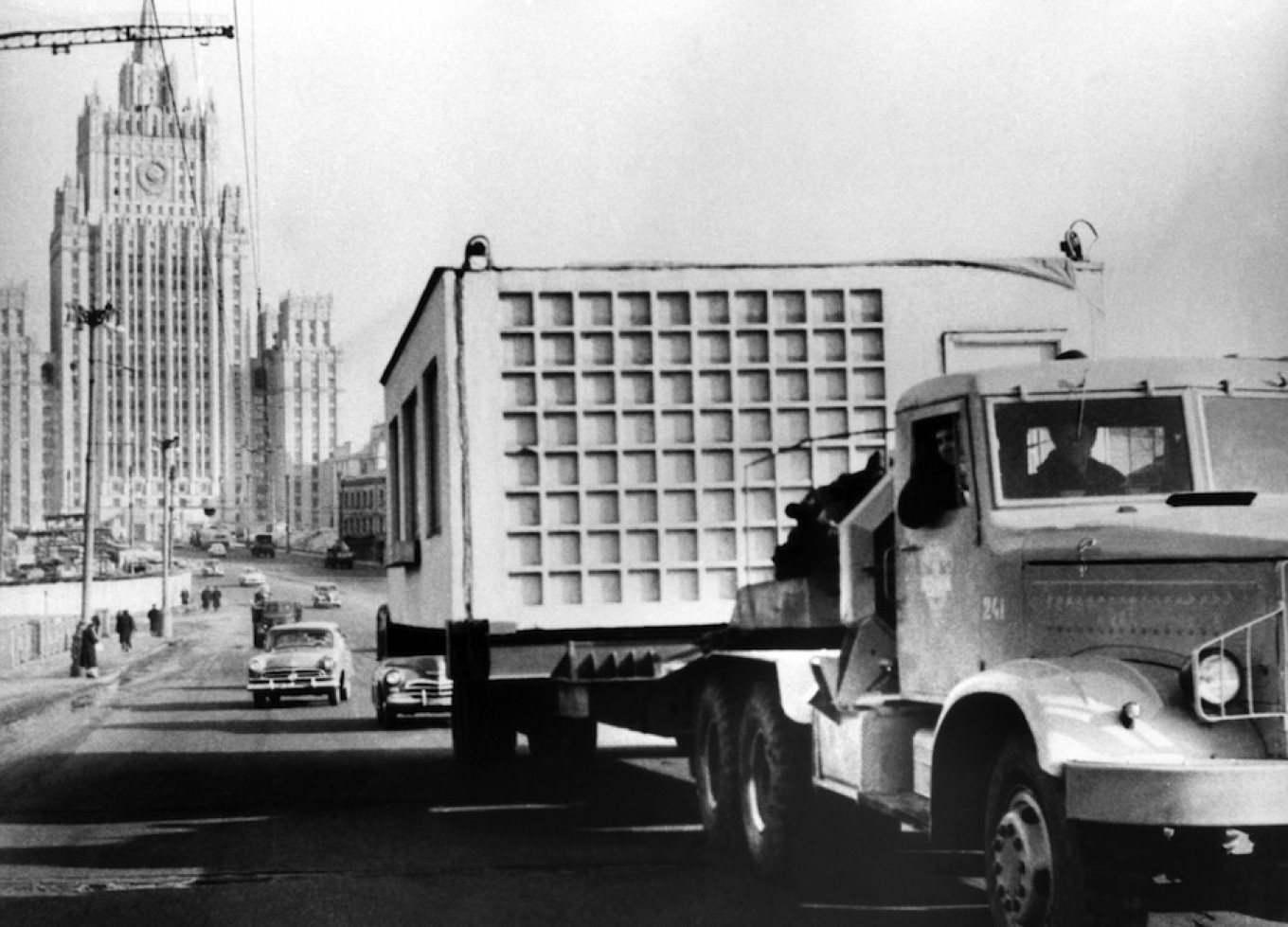
A truck transports parts of a Khrushchevka in 1960, Moscow, Soviet Union.
Read More https://www.themoscowtimes.com/2017/03/09/goodbye-khrushchev
Subscribe to:
Posts (Atom)